A sense of place as a place to begin healing

I am blessed to live in Nu‘uanu Valley just outside the center of Honolulu. It was a place where our kings and queens retired during the hot days of summers past to enjoy the cool winds and gentle mists. It remains a convenient and enjoyable place to escape the pace and heat of modern city life.
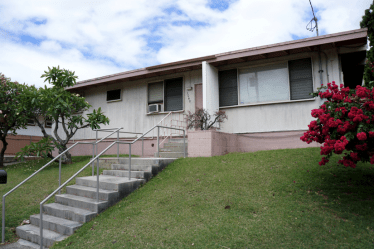
bachelotThanks to the generosity of the United Church of Christ- Judd Street, our Foundation has enjoyed having its administrative hub in the former manse of the church at the very door of Nu‘uanu. For over a decade we have dealt with the management of a growing statewide organization dedicated to positive transformational change for needy Hawaiian children and their families. Free traveling preschools, preschools in homeless shelters and on the beaches, foster parenting and recruitment, care for adjudicated young men, and more all get support from our small office in Nu‘uanu.

It is interesting to remember that through this valley in May 1795 swept the army of Kamehameha, as he completed defeat of Kalanikūpule’s army and his conquest of O‘ahu as he went on to unite all the islands under his reign (see www.pacificworlds.com/nuuanu/native2cfm). Just a few blocks from the office is the resting place of most of the kings and queens of Hawai‘i at the Royal Mausoleum and further into the valley the former home of our Queen Emma and the remains of the summer home of Kamehameha III. At the end of the valley is the sharp precipice of the Nu‘uanu Pali, the beautiful and stunning “wall” of the cliffs of the Ko‘olau Mountains, and the expanse of the windward side of the island.
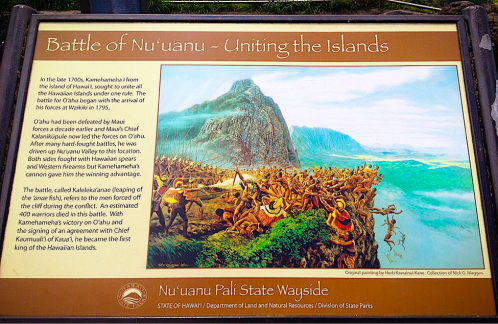
battle of nuuanu

All great stuff, but how does it relate to all of us trudging through the challenge of life in the 21st century and the trying to make a difference in the lives of the needy in our community? That was a question that crossed my mind a few months ago and I thought that it might be important to revisit the concept of “wahi pana” as it relates to Nu‘uanu, Kalihi, and Kapālama, the neighborhoods we live and work in.

Wahi pana is a concept in Hawaiian culture that celebrates the places around us. Each place has its unique and special history, heroes, songs, traditions, stories, etc. that set it apart from other places and that give those who live there a powerful sense of tradition and identity. In traditional Hawaiian life it was the glue that helped create strong connections between people from a certain place which, in turn, helped to unite them in powerful community.  Today there is a strong tendency to socially “homogenize” and “pasteurize” us and in many ways discount the unique “sense of place” our forefathers cherished.

The more I thought about it, the more I felt that “wahi pana” might be a unifying factor to bring the various agencies and communities of faith in the Valley and in Kalihi and Kapālama together. Instead of ignoring our sense of place, we could lift it up to help unite us in our service to the community. Not rocket science, but the response to our initial gathering has been amazingly interesting.

As we scratched the surface of the history of Nu‘uanu, Kalihi, and Kapālama, we were reminded that this was a place that was much more than a battlefield. It was a place of healing heiau, enlightenment, knowledge, and learning (Kapālama), and a place of abundant provision for the people. The extensive ‘auwai system of irrigation provided food for the people, the heiau provided care for the injured and disabled, and learning and enlightenment was symbolized by the abundant lamalama forests of the hills above.

We asked our partners in service to the community to come together to celebrate our special “wahi pana” with song and fellowship. It was a blessing to watch as good hearted and generous people stepped back from service to join with those they didn’t know, around the special sense of place they share! Last Saturday, April 22, 2017, a number of ethnic groups, churches, schools, and interested individuals who are working for social justice in our community came together to share music and fellowship at St. Mark’s Coptic Church. To see and hear Tongan, various Micronesian languages, Hawaiian, English, and Coptic liturgy blended together in song and testimony gave a testimony to the “wahi pana” of this place as a place of enlightenment, knowledge, and care for the needy! As we rejoiced in the music of our cultures, we had a chance to connect with each other around our commitment to our community, and as a result took from those two hours a blessing and a deeper understanding of the joy of serving!

It is so simple yet so amazing, this discovery of rich blessings in our places of service. Let’s work to tune our hearts to the beat of those who have gone before us in servant leadership! How rich is their inheritance for us, if we but only open our eyes and hearts to it! Me ke aloha piha.

PIDF has produced several Wahi Pana videos. Please feel free to view them by clicking on each location below:

North Kohala

Waimea

Waihe‘e

Hilo

Waimānalo

Ka‘ū

Kalaupapa and its Legacy in Hawaiian Families: How Tragedy Begets Pride

I’d like to continue the saga of our ‘ohana’s upcoming adventure of discovery to Kalaupapa. As I mentioned in my last post, our pake (Chinese) cousins Stanley Chong, et.al., are planning to revisit the grave of his grandfather, Tung Shu Fung (otherwise known as Tommy Fung), the one-armed carpenter of Kohala. Mr. Fung had been sent to Kalaupapa in the 1920’s and died there in 1945. Because I believe we’re related to the Fungs through Amoy Chock Fung (his wife and my caregiver when I was growing up), we’ve joined forces and hope to be with the Fung clan at the former leper colony on May 11th and 12th.

Our side of the family, the Hawaiian side, has for years whispered the story of our relative Hana Pelio Kapakahi being sent to the leper colony because of a land/water dispute with the Pioneer Mill Company of Lāhainā. Thanks to records and other information provided by Ka ‘Ohana O Kalaupapa and Valerie Monson, we were able to confirm that Hana was sent to Kalaupapa in December of 1890 and subsequently died there in March of 1904. This simple fact triggered a growing fascination in understanding this special place and how our relatives got there. The more we learned, the more astonished I’ve been at this piece of Hawaiian and family history. It is a mystery, tragedy, and tale of triumph and deception all rolled into one. It is a journey I believe many Hawaiian families have taken. I say this even though we have only just begun the challenge of understanding and documenting it for ourselves and for the future generations!

Our ‘ohana “team” set for the adventure in May will include our Chinese side relatives: Stanley Chong, his sister Millie Dillon, her husband Brian (a for real professor of archeology), and two other Fung relatives. The Hawaiian gang will include: our daughter Katie Johnson, our son Matthew Dill, our oldest mo‘opuna (grandson) Hayden Butler, and our nephew Thomas Chock. The Fungs want to revisit Tommy Fung’s grave and we want to also find Hana’s grave and honor her memory. We were told that there is no clear record of her gravesite, but the story of Hana’s time at Kalaupapa gives us hope that we can find it.

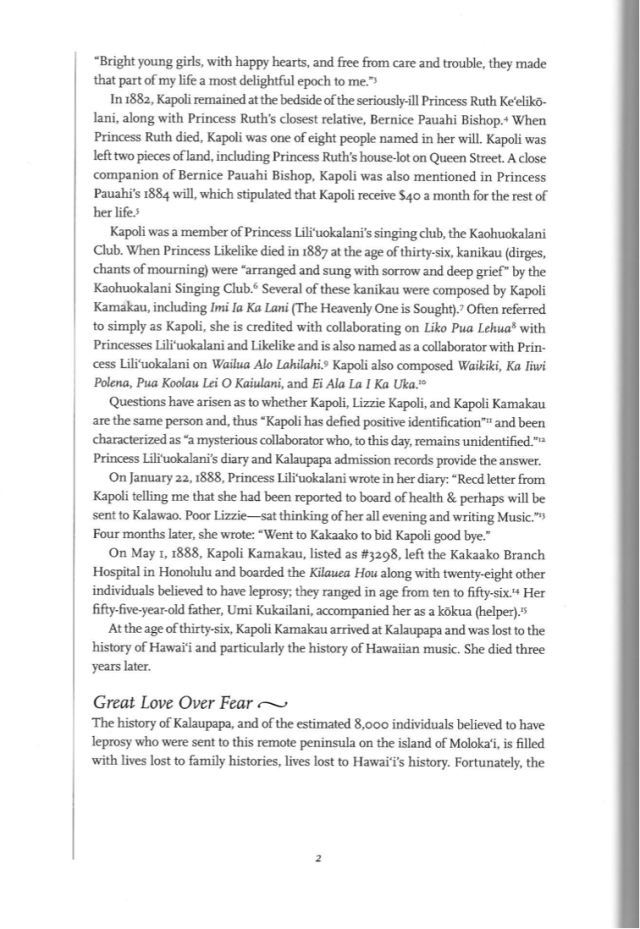
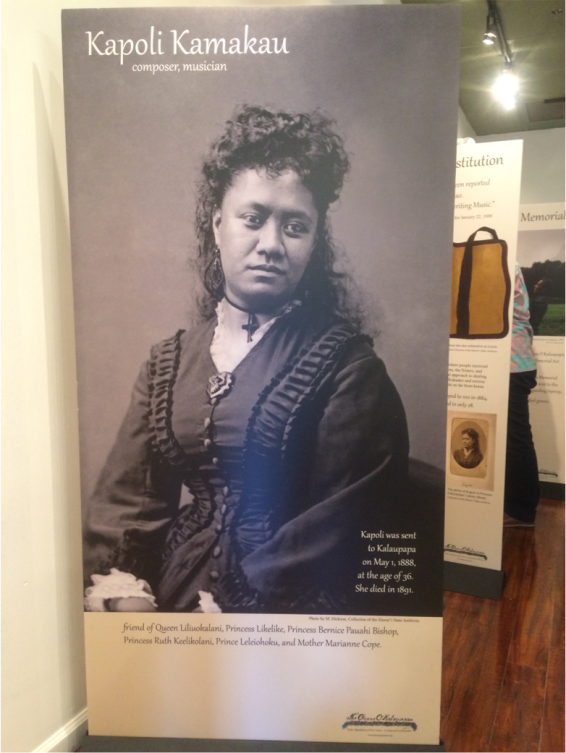
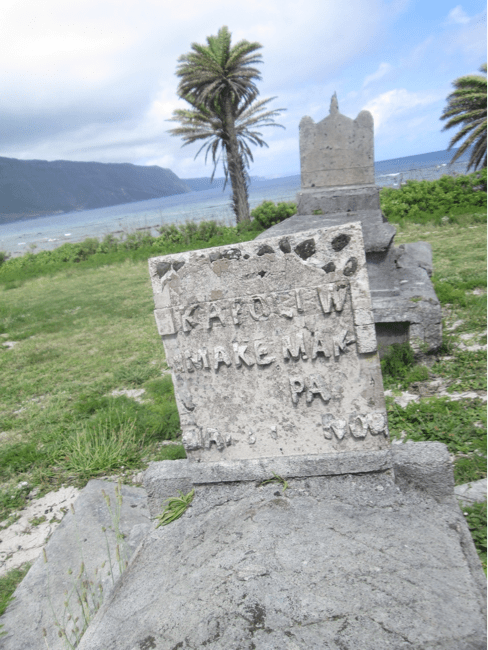
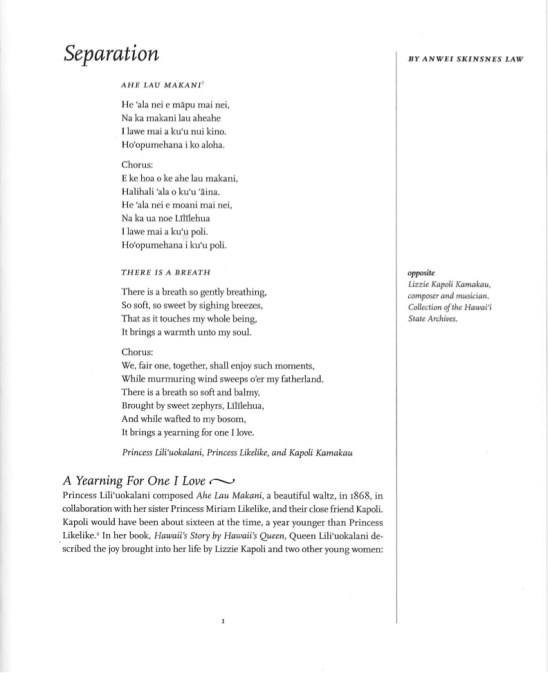
Hana came to Kalaupapa at the end of 1890. On August 8, 1891, Hana married a man named Umi Kuka‘ilani, who was born at Kalaupapa and had returned there as a “kōkua” (caregiver) for a woman named Kapoli Kamakau. Come to find out, Kapoli was a dear friend and companion of Queen Lili‘uokalani and a co-author with her on several songs. Kapoli was also close to Princess Ruth Keʻelikōlani and Bernice Pauahi Bishop, both of whom left property and a stipend for her in their wills.

kapoli book
Mention of Kapoli in excerpts from “Kalaupapa: A Collective Memory” by Anwei Skinsnes Law

kapoli book2

All of this tweaked my interest and reconfirmed the rumblings of my mother and uncle in years gone by, about our family’s relationship with Hawaiian royalty. Since most Hawaiians make this claim I had filed this assertion in the dead letter file of family fantasies. All of a sudden, however, our adventure to Kalaupapa was reviving this mysterious family tale and triggering several interesting questions to address. Who was this man Umi Kuka‘ilani and what was his relationship with Hana and Kapoli before Kalaupapa? Who was Kapoli and what was her relationship to the Kamehameha line? Finally, could we get a handle on the events that led to Hana’s banishment to the leper colony and was it related to the land/water issue that had haunted the family stories of the past?

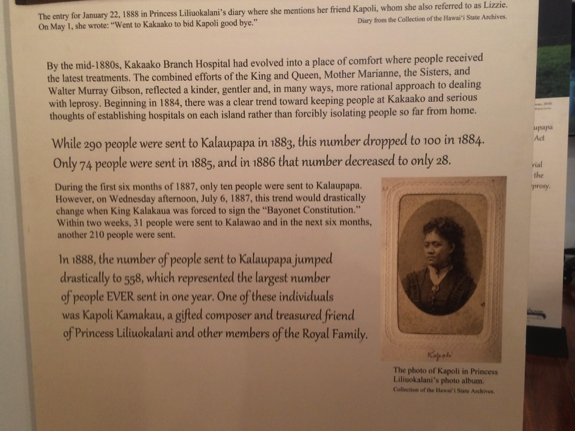
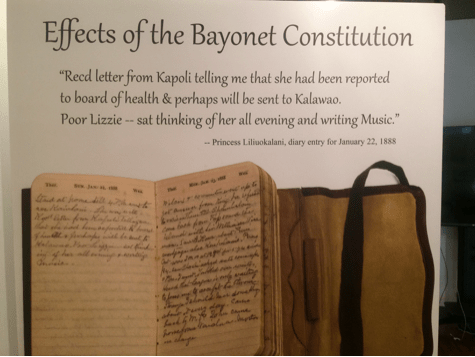
We are just beginning the adventure, but the first pieces of the puzzle are amazing and encourage us to continue to try to understand this part of our family’s history. First, we have indeed found out that Kapoli Kamakau was a close friend of the Kamehameha family and the Kalākaua royal line. Queen Lili‘uokalani mentions her aloha for Kapoli in addition to writing songs with her. Princess Ruth, owner of the vast lands of Kamehameha that she later bequeathed to her cousin Bernice Pauahi, held Kapoli in high enough esteem to leave her a house and property in Honolulu in her will. Pauahi also considered Kapoli close enough to provide a monthly stipend of $40.00 in her will. It is obvious that Kapoli was esteemed and loved by her friends.

kalaupapa exhibit
The new Kalaupapa exhibit at the Royal Hawaiian Shopping Center, PC: Stanley Chong

kalaupapa exhibit3kalaupapa exhibit2

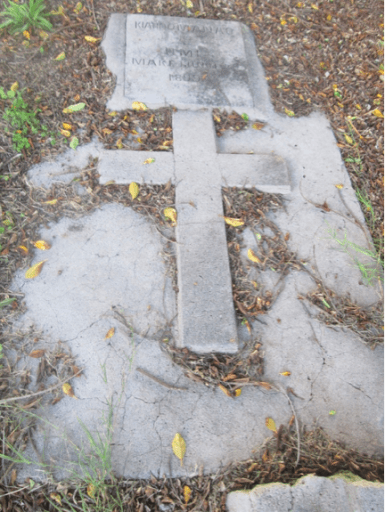
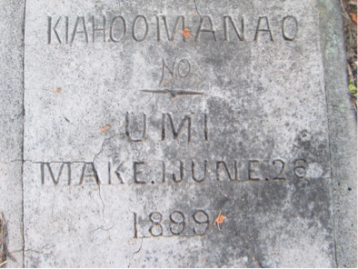
Who then was this man Umi? We were told initially that he was originally sent to Kalaupapa to be a caregiver for Kapoli. His sketchy records only state that he was born at Kalaupapa in 1833 and then returned there as a patient in November of 1893. Lots of these dates are in the process of being sorted out, but Umi emerged as an even more interesting individual when we were told by the Kalaupapa Park Genealogist that Umi was, in fact, the father of Kapoli Kamakau! Other records confirm that he accompanied Kapoli as her caregiver when she was sent to Kalaupapa from Honolulu on May 1, 1888 (along with 28 others believed to have leprosy). It is assumed that he contracted leprosy while living in Kalaupapa to care for Kapoli, became a patient himself in 1893 (2 years after marrying Hana), and subsequently died in June of 1899. It is unknown whether he knew Hana before he returned to Kalaupapa and whether Kapoli was at their wedding, as Kapoli died that same year in 1891. The plot thickens, so to speak, but it augers well for the grave search since we believe Umi’s gravesite is known, and if so, Hana’s grave should be close.

kapoli grave
Kapoli’s grave at Kalaupapa
umi grave
Umi’s grave

umi grave2

The final thread of interest involves the legal suit to recover the land/water rights taken from Hana after her first husband, Joseph Likona Kapakahi, died in 1887. Around the time she sued to reclaim the land, she was declared a leper and sent to Kalaupapa. In the account of the appeal submitted in 1899, Hana and Umi bemoan the fact that they cannot travel to take part in the trial over the land ownership. Unfortunately Umi died only 4 days after they submitted the appeal. It was painful to read the description (which you are welcome to read here: Hana Umi Kukailani vs Pioneer Mill Co. 1899). After Hana (who was my maternal grandmother’s great aunt) died in 1904, my grandmother’s half sister’s husband, the plantation doctor in Lāhainā, was appointed executor of Hana’s estate. The contested land was sold to the Pioneer Mill Company and the good doctor and family moved to Albany, New York.

All of the above point to the astounding richness of one’s family’s history if we take the time to ask the questions and listen to the answers! I hope all of us in our family will get to know the whole story of Hana, Umi, and Kapoli so that we can appreciate the heritage of courage and perseverance we are called to imbed in our lives. I’m sure all of you can come up with your own family tales of hope! It will be worth the effort! Stay tuned for the next chapter of our saga. Me ke aloha pau‘ole.