A Family’s Journey of Discovery in Kalaupapa

A few months ago, I shared the start of a family journey of discovery involving ancestors who had been sent to Kalaupapa, the leper colony established by the Hawaiian Kingdom in 1866. When our Chinese relatives announced that they were going to revisit the grave of their grandfather Tommy Fung, I was reminded of family stories that claimed my tutu wahine’s great aunt, Hana Pelio Kapakahi, was sent to the leper colony under suspicious circumstances (primarily centered on the fact that she was suing Pioneer Sugar Co. in Lāhainā to reclaim land and, importantly, water rights owned by her deceased husband Joseph Likona Kapakahi). We had never pursued the issue and it seemed the visit to Tommy Fung’s grave might give us a chance to explore the fate of Hana.

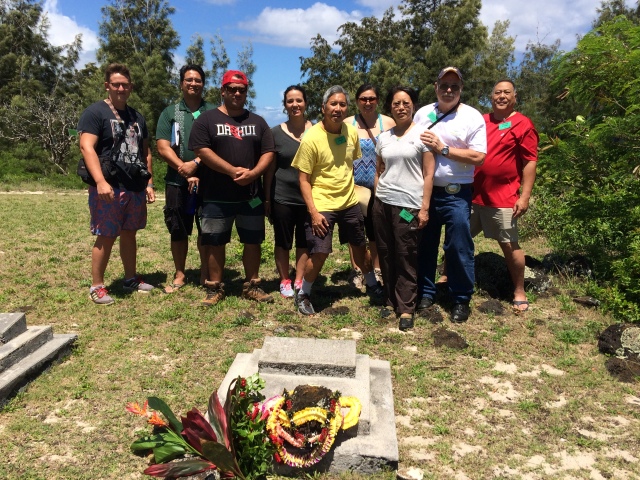
Thanks to the great hospitality and help of Ka ‘Ohana O Kalaupapa, particularly Valerie Monson and the National Parks Ranger stationed at Kalaupapa, Kaohulani McGuire, our group of nine extended family members made their way to Kalaupapa on May 11th and 12th. All were overwhelmed by the beauty and majesty of Kalaupapa and Kalawao. Most of the big buildings have been destroyed, but a number of houses and churches remain.
IMG_0578

Our Chinese cousins focused on revisiting Tommy Fung’s resting place while my son Matt, my daughter Katie, my mo‘opuna Hayden, and my nephew Thomas were faced with the challenge of finding the graves of Hana Pelio Kapakahi Kukailani, her husband Umi Kukailani (whom she married at Kalaupapa in 1891), and his daughter, Kapoli Kamakau. It’s amazing what you can set your mind to do when you don’t know what you’re doing!
IMG_0605
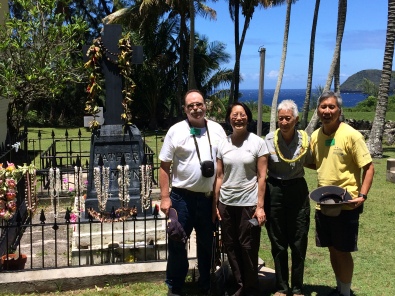
From right to left: My cousin Stanley Chong, Park Ranger Kaohulani, Stanley’s sister Millie Dillon, and her husband Brian

The hospitality and support of Ka ‘Ohana O Kalaupapa and Ranger McGuire allowed our family expedition to achieve most of its goals. Tommy Fung’s grave was cleaned and decorated with the appropriate prayers in English, Hawaiian, and Haka. The graves of Umi and his daughter Kapoli were also cleaned and prayed over. Although the marked grave of Hana was not discovered, a grave next to Umi was assumed to be hers. The toll of tidal waves and neglect have destroyed or damaged most of the graves at Kalaupapa, so we are happy that some of the surviving ones include most of our kūpuna. Over 8,000 people were buried and only a small number of the graves are actually marked. It speaks to the need that Ka ‘Ohana O Kalaupapa is pursuing, to build a Vietnam type memorial with names for all those who lived and died there.
IMG_8264
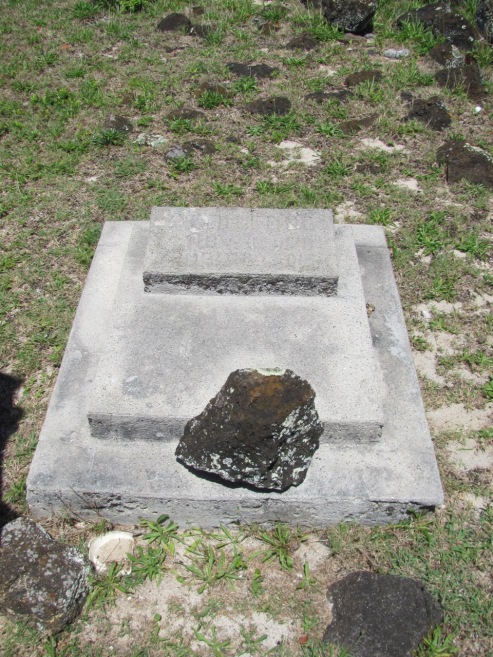
Grave marker for Tommy Fung (Fung Tung Shu). The inscription is rapidly eroding and only visible at dawn and dusk. Our relatives are talking about placing a new marker plate for the grave, something we’d like to do for our relatives as well.
IMG_0610
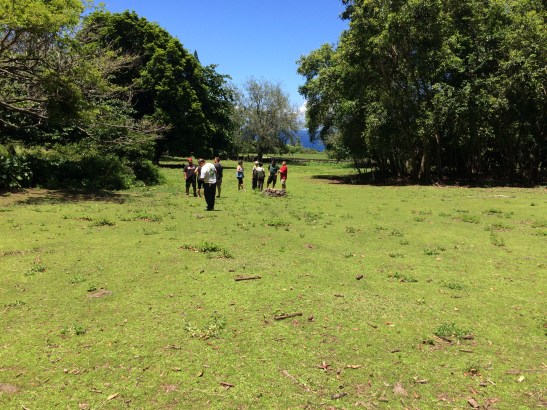
Future Kalaupapa memorial site

The outcome of the two days in Kalaupapa has been a deepening understanding and respect regarding the challenges our kūpuna faced during the turbulent days of the last decade of the 19th century. Political, social, economic, and spiritual shifts were overwhelming the Hawaiian Kingdom and Kalaupapa was a dramatic microcosm of that period. With the imposition of the Bayonet Constitution of 1887 by the landed white elite on the Kalākaua administration, the expansion of plantation production kicked into high gear and land/water issues such as the one Hana and Umi were fighting with Pioneer became a part of many Hawaiian family histories. Some claim the leper colony became a solution to opposition from landowners to the march of corporate production, and point to the curious uptick of leprosy patients sent to Kalaupapa after 1887 (a good deal of them diagnosed by plantation doctors). It is hard to tie the causal knot, but it does create interest in actually sorting out the stories of our kūpuna in that place. It is probable that many other Hawaiian families also had members sent to the colony.

Subsequent to the May expedition we are discovering more information about Umi and Kapoli and about other rumored members of the family who were sent to the leper colony. Hana and Umi fought for the land and water rights in Kaua‘ula in Lāhainā but as they pointed out in their filings before the courts, they were at a great disadvantage due to their exile at Kalaupapa. The suit stayed alive until Hana’s death in 1904 when the land and water rights issues were transferred to Hana’s heir, Hattie Namo‘olau Ayers, my great grandmother. Upon Namo‘olau’s death in July 1907, an executor was appointed by the court at the request of Rosina Georgiette K. Dinegar, my tutu wahine’s sister and one of the daughters of Namo‘olau. The executor requested and selected by the court was her husband Dr. Robert H. Dinegar, the plantation doctor. The details of the sale were never made known to the family, but subsequent to the settlement, the doctor and his family left immediately for Albany, New York. They never returned. Life is messy, relentless, and often mysterious!

It is clear that this place has very special meaning to Hawaiians and to Hawai‘i. Through all of this is woven the stories of sacrifice and aloha of Father Damien, Sister Marianne Cope, and many others who ministered to the abandoned.  Unbelievable people of faith! (Historical note:  Sister Marianne Cope predicted that she and her fellow nuns would be protected from leprosy.  None ever got it.  She also sent all the schoolbooks back to Honolulu and demanded that Hawaiian language books be sent for the children.)

The more we scrape and stir, the richer the brew of personalities, human triumphs, tragedies, and unanswered questions!  Stay tuned for reflections on the trip from the Dill/Chock team.

Clearing the Fog

I’ve found that my grumbling and mumbling about the shortcomings of our policy makers and implementers helps to clear my vision in the midst of the competing noises and posturing of our political leaders… just what are the important issues? Local, state, and national politics are stunning, even for a person like me who thought he had seen it all. Often, however, we exhaust ourselves on the external issues that stir us, the policy issues (or the lack of policy issues) as they relate to aspects of life I believe are important for us as a community. How come we don’t have a sustainable agricultural production plan for our precious lands? Where is the renewable energy strategy we were promised and what are we doing in its seeming absence? How do we know we will have sufficient water resources for our children and grandchildren? Where is our comprehensive early education plan to insure our children and families are healthy and resilient?

It goes on and on and I tend to get stuck in the weeds with the details of the issues. Venting is helpful however, in that it gets all of the negative weight off my brain and helps me clear a path to the underlying and fundamental aspects of our system that need our attention. Once I’ve gotten all of the negative energy out of my system by grumbling, arguing loudly, or burning in silence over the stupidity of people who don’t agree with me on issues, I can finally consider and explore what it would actually take to bring health and resilience to our community through our political process. The real need is to change the system and culture that drive these issues.

Forty years ago I listened to a taped speech by a pastor’s wife, Jill Briscoe. She was commenting on the reaction of traditional churches to the revival that was taking place in England. As more and more young people came to faith and showed up at the church’s doors, the traditionalists struggled with what to do with all of the “Jesus Freaks” the revival had produced. Their dress, language, behavior, hair, and attitudes were outside of the box of traditional church culture. Many of the traditionalists worked diligently and struggled mightily to change their dress, change their language, and mold them into good traditional British Anglicans! Jill Briscoe likened the process to trying to get all of the dead leaves off the tree in the early winter. You can labor to climb each limb and pick each remaining vestige of a dead system, or you could wait until the spring breaks forth and allows the tree to replace the dead with the vibrant signs of new life! The more I thought about it, the more I realized that I was probably climbing limbs to remove dead issues from our political process rather than paying attention to the system that produced it!

full tree dead tree

So, one asks, how do you grapple with an organizational system that behaves like an octopus? Its various arms keep moving us around and it keeps changing colors and appearance to a point of confusion. What is the key to making the system responsive to creating a healthy and resilient community rather than one that feeds the egos of the leaders? I think the answer takes us back to the picture of a dead tree and the need to bring life back to the trunk if the leaves of the issues are going to be healthy and vibrant. By recruiting and training men and women to be servant leaders, we can begin a truly transformational change in our local, state, and national governments. History has taught us that one or two committed servant leaders can bring substantive change to a system.

How do we do it, you ask? It begins, I believe, at various levels in our lives. It is hard to expect our children and grandchildren to embrace servant leadership if they aren’t given models consistently in their lives! How do we convey to our ‘ohana the responsibility to care for those in need, to strive for and seek excellence and honesty in all that we do, and to work to bring people together rather than use them as springboards for our own egos and personal plans? A few moments spent reflecting on how we can model the principles of servant leadership for those we love, can be a powerful beginning to a significant process of change.

As we commit to model servant leadership, we also have to ask those around us to do the same. As we come together with like-minded men and women, we begin to develop a shared vision of health and success for our families and our communities. We begin to recognize and define the values and the behaviors that should characterize our families, neighborhoods, and towns. In essence, we begin to “speak” a language and model behaviors that strengthen servant leadership in our lives and the lives of those around us. It hopefully begins a process of widening acceptance of servant leadership in families, neighborhoods, workplaces, and ultimately in public policy formulation.

I think it is important to emphasize the need to identify, recruit, and train men and women who seek to apply servant leadership in the public policy arena. There is a growing interest in this concept both locally and nationally. Most of us are tired of individual egos speaking the language of self-promotion as the only alternative for political leadership in our local, state, and national governments. To change this, intentional action has to emerge. If we can begin a process of identifying men and women with hearts of service and if we can prepare them for the huge challenges they will face in running for office and serving as our political leaders, we can begin the process of public policy formulation based on deep rooted servant leadership. We can begin to strengthen our communities in their commitment to transformational change and care for the needy.

We are exploring a program called Pono Policy Training…”pono” being the Hawaiian word for righteousness and right relationships…in which individuals will be invited to learn how the political system works and to explore how servant leadership can bring substantive change.

nvng no background


On the national level similar programs are beginning and despite the tremendous challenges they face, they are beginning to gather traction. People are tired of climbing the dead political trees to pull down policies and practices they oppose. They want to be part of bringing our political systems back to life and relevance by resetting the goals of governance within a framework of responsible servanthood.


Enough said for the present. Let’s see if we can start by gathering together in small groups to commit to servant leadership, modeling it in our homes, neighborhoods, and workplaces as a means of bringing our communities back to health and resilience!